
Roblox Obby Maker
Roblox Obby Obstacles: 14 Ideas, Easy to Hard
Jumps, climbs, hazards and timing puzzles, roughly in the order they belong in a course, with how to tune each one and what to check.
Obby obstacles are the challenges between checkpoints: jumps, climbs, hazards and anything that moves. Below are 14 of them, from the ones that belong in the first stages of a course to the ones that suit the end. For each one you get where it fits, how to make it harder, what to ask for when you describe it in PromptBlox, and what to test in Roblox Studio.
The pictures show possible shapes and themes. What you get depends on your description, so ask for the behavior as well as the look: a spinning bar needs a speed, a direction and a rule for what happens when it hits a player. To plan the whole course around these, see the obby maker page.
The 14 obstacles at a glance
| Obstacle | Where it fits | Skill it tests |
|---|---|---|
| Platform jumps | Opening stages | Judging a landing |
| Rainbow steps | Opening stages | Climbing a route |
| Tree climb | Opening stages | Climbing around a landmark |
| Hazard stairs | Early middle | Reading safe and unsafe |
| Lava floor parkour | Early middle | Staying on safe ground |
| Conveyor crossing | Early middle | Moving against a push |
| Round stepping stones | Early middle | Precise landings |
| Diamond platforms | Early middle | Aiming for the landing |
| Spiral tower | Late middle | Long vertical climbs |
| Ice slide | Late middle | Controlling speed |
| Rotating bars | Late middle | Timing a crossing |
| Disappearing bridges | Late middle | Reading a warning |
| Swinging platforms | Late middle | Landing on something moving |
| Wall-to-wall climb | Final stages | Turning between jumps |
Obstacle ideas to build on
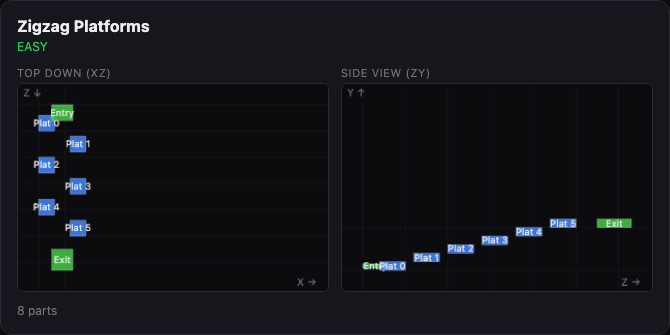
Opening stages · Judging a landing
Platform jumps
Separate platforms with gaps between them. Every obby starts here, because it teaches the one skill every later obstacle needs.
To make it harder: Smaller platforms, longer gaps, a change of height or direction between jumps.
What to request: Wide platforms and short gaps first, then a gentle zigzag with arrows that point to the next landing.
What to test: Reach every landing with normal movement, including when you arrive at an angle.
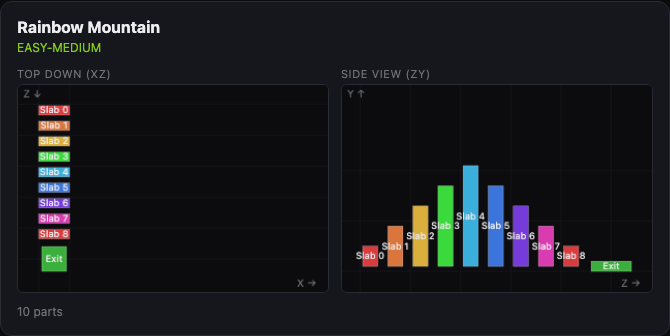
Opening stages · Climbing a route
Rainbow steps
A rising path of colorful steps that shows players where the course is heading. The same layout works as a candy mountain, a temple stairway or a cloud climb.
To make it harder: Narrower steps, taller rises and a turn with no ledge to stop on.
What to request: Broad early steps and a flat rest platform where the route changes direction.
What to test: Every rise can be jumped, and no step color looks like a hazard.
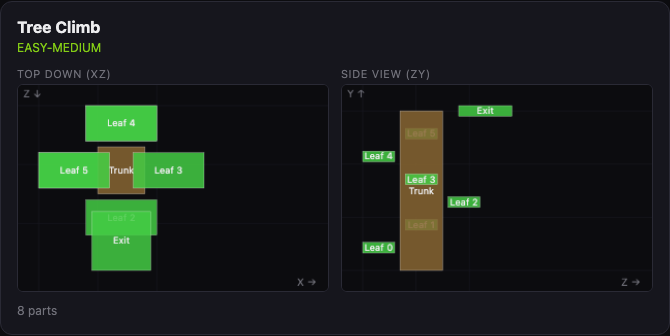
Opening stages · Climbing around a landmark
Tree climb
Branches or leaves wind around a trunk toward a treehouse or lookout. The trunk is a landmark, so players always know which way is up.
To make it harder: Fewer and thinner branches, wider spacing, a jump to a second tree.
What to request: Camera space around the trunk and a wide branch to rest on before each harder climb.
What to test: Circle the trunk and look for leaves that block the camera or hide the next branch.
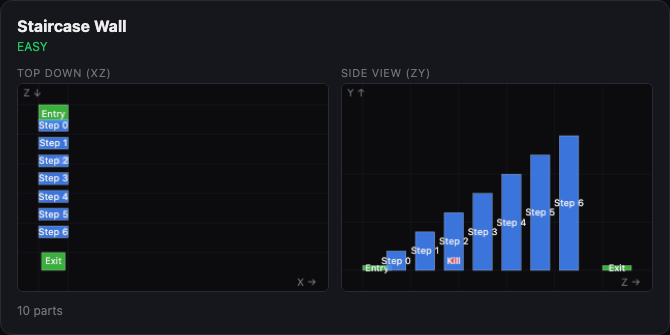
Early middle · Reading safe and unsafe
Hazard stairs
Stairs where some steps or strips are kill bricks. The challenge is reading the safe path, usually the first hazard a player meets.
To make it harder: A narrower safe strip, and hazards that move from side to side between steps.
What to request: A clearly different color for hazards, a visible safe path, and a first step wide enough to learn on.
What to test: Walk the safe edge, then touch a hazard on purpose. The deadly area should match exactly what players can see.
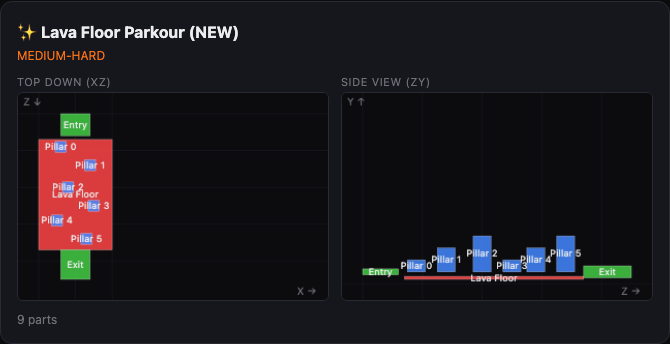
Early middle · Staying on safe ground
Lava floor parkour
Pillars and stepping stones over a floor that sends players back. Water, acid or an energy field can play the same role if the prompt says what touching it does.
To make it harder: Smaller pillars, pillars at different heights, or pillars that sink while you stand on them.
What to request: Safe surfaces that stand out from the floor, and a checkpoint just before the crossing.
What to test: Fall off both sides and try the scenery. Every fall should send you back, and no decoration should become a shortcut.
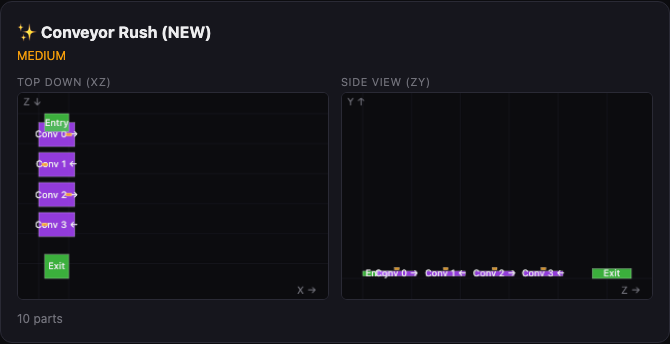
Early middle · Moving against a push
Conveyor crossing
A moving belt that pushes players while they cross. Arrows on the belt let players see the push before they step on.
To make it harder: Faster belts, belts that run in opposite directions, gaps between belts.
What to request: One slow belt first, marked with arrows, before any gaps or opposing belts.
What to test: Stand still, walk against the belt and jump off it. Check where the belt actually carries you.
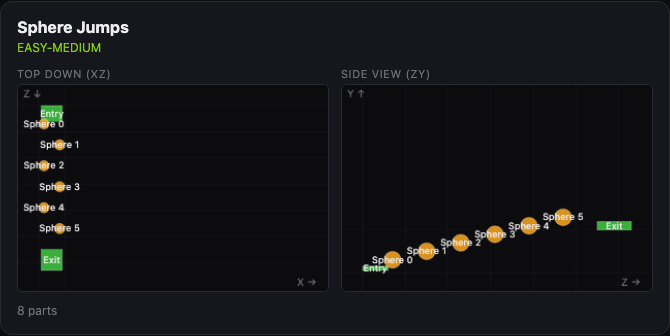
Early middle · Precise landings
Round stepping stones
Balls or domes instead of flat platforms. The round top makes the real landing area smaller than it looks.
To make it harder: Smaller balls, wider spacing, a ball that slowly rolls or bobs.
What to request: Generous early spheres with flat-looking tops that are easy to see.
What to test: Land on the center and near the edge. Watch for sliding off, or a jump that only works from one exact spot.
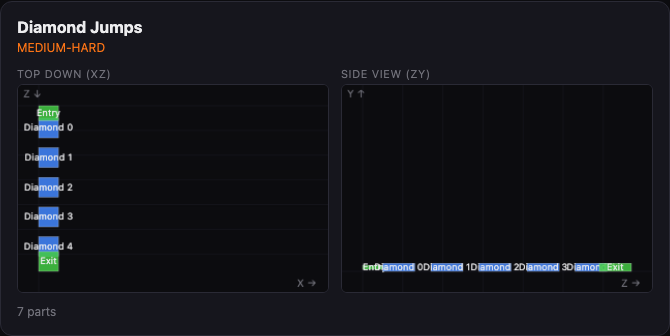
Early middle · Aiming for the landing
Diamond platforms
Angled platforms that change the landing's shape without a new movement rule. They suit crystal caves and floating ruins.
To make it harder: Turn the narrow point toward the incoming jump, or shrink the diamonds.
What to request: Point the widest part of each diamond toward the jump that lands on it.
What to test: Land on the corners and make the exit jump from each one; the whole row should work in order.
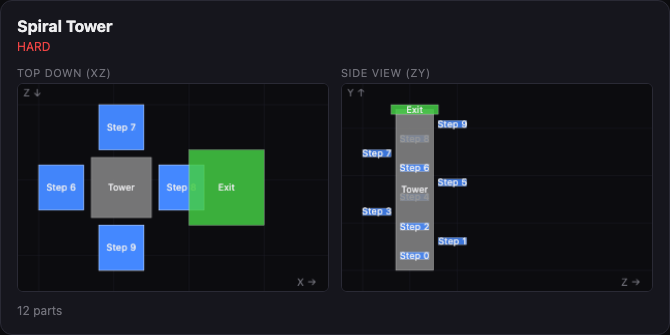
Late middle · Long vertical climbs
Spiral tower
Platforms that wrap around a central tower. Height makes every fall feel bigger, so the checkpoints matter more here than anywhere.
To make it harder: Remove rest ledges, add a moving platform partway up, leave longer gaps between turns.
What to request: The next platform visible around each turn, and checkpoints on roomy ledges along the way.
What to test: Climb the whole tower and fall from several heights. You should always land back at the right checkpoint.
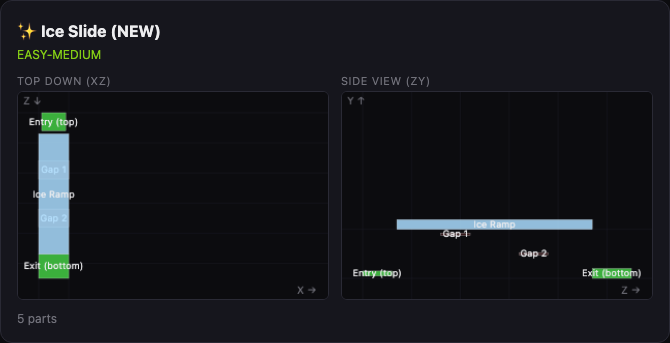
Late middle · Controlling speed
Ice slide
A slippery slope that links two parts of a course. The exit matters most: speed should carry players somewhere useful, not off the edge.
To make it harder: Turns on the slide, walls with gaps, a jump at the bottom.
What to request: A gentle first slope, visible side walls and a wide landing at the bottom.
What to test: Enter at different speeds and steer on touch controls. An ice look alone does not make the surface slippery; check how it actually moves you.
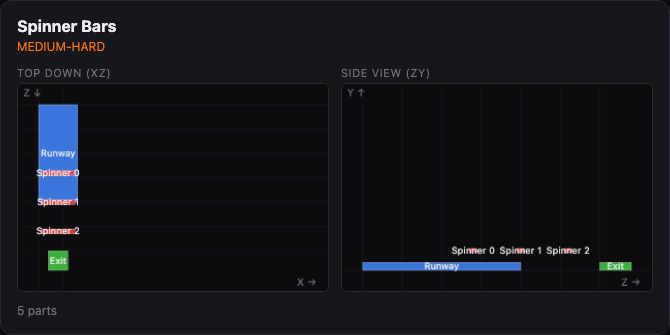
Late middle · Timing a crossing
Rotating bars
A spinning beam that sweeps across a platform. Players wait, then jump or run through the gap. Its speed and the space around it set the difficulty.
To make it harder: A faster spin, two bars at different speeds, a narrower platform underneath.
What to request: A slow, brightly marked bar and a safe spot where players can watch it before they go.
What to test: Cross several times from both sides, with two players, and check that being hit always does the same thing.
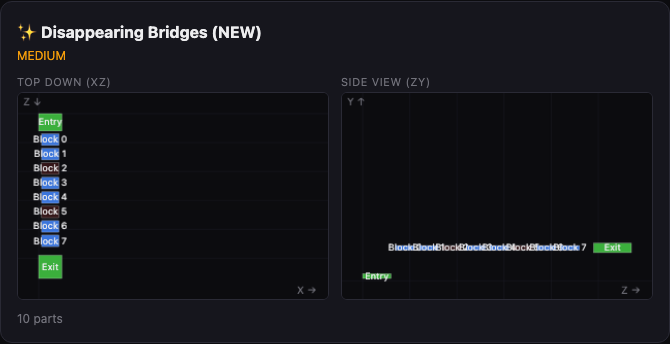
Late middle · Reading a warning
Disappearing bridges
Bridge sections that vanish and return. A warning, such as a flash or a color change, turns guessing into timing.
To make it harder: A shorter warning, a longer bridge, sections that vanish out of order.
What to request: A clear warning before each section disappears, and a safe ledge to wait on while it comes back.
What to test: Cross at the start and at the end of the warning. The part you see and the part you stand on should vanish and return together.
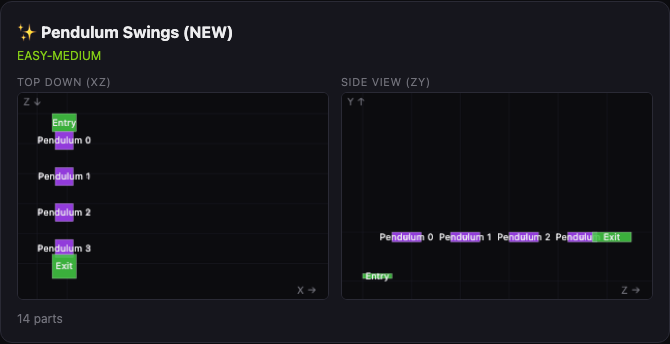
Late middle · Landing on something moving
Swinging platforms
A platform on a swing that changes where the player has to land. It works best as a short crossing between two safe ledges.
To make it harder: A faster or wider swing, a smaller platform, two swings in a row.
What to request: A steady swing, a broad platform and a waiting ledge at each end.
What to test: Ride the platform as well as jumping on and off. It should carry you, and the exit should stay reachable through the whole swing.
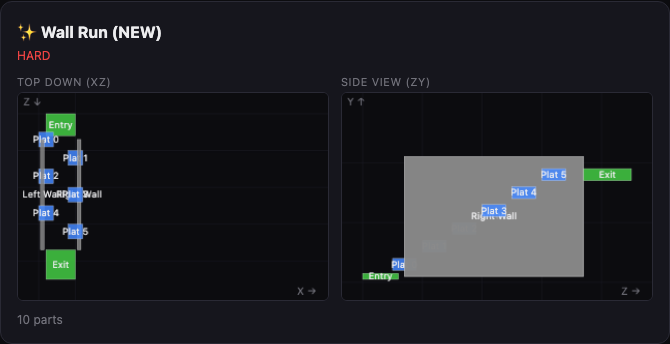
Final stages · Turning between jumps
Wall-to-wall climb
Ledges on two facing walls, so players turn around after every jump. It uses normal jumping; actually running along a wall is a separate mechanic to ask for by name.
To make it harder: Smaller ledges, more height between them, no ledge to rest on halfway.
What to request: Alternating ledges with room to turn, clear headroom and a visible exit at the top.
What to test: Climb with the normal camera and make sure no jump secretly needs a wall-running ability you did not ask for.
What makes an obstacle fair
- Readable: safe parts look safe and dangerous parts look dangerous, in the same colors all course long.
- Reachable: every jump works with the movement players have, on a keyboard and on a touch screen.
- Learnable: anything that moves does so on a steady rhythm players can watch before they commit.
- Recoverable: a checkpoint sits before the obstacle, so a failed attempt costs seconds, not the whole stage.
- Visible: the camera can see the landing, with no scenery hiding it.
Combine obstacles carefully
Difficulty comes from the sequence as much as from each obstacle. A swinging platform beside a safe ledge is fair; the same platform straight after a blind jump is not. Some combinations that work:
- Platform jumps, then a slow conveyor: the same jumping skill with a push added.
- Hazard stairs into lava parkour: reading safe ground, then standing on it.
- A spinning bar on a wide platform, later on a narrow one: the same obstacle, harder the second time.
Avoid two timing obstacles with different rhythms back to back early in a course, and never put a new obstacle where players cannot see it before they land.
Describe an obstacle in PromptBlox
Name the obstacle, then give it numbers: how fast it moves, how long a warning lasts, what touching it does and where the checkpoint is. You can ask for a single stage inside a project you already have:
“Add a stage with three disappearing bridge sections over lava. Each section flashes orange for one second, disappears for two seconds, then comes back. The sections go in order from left to right, so players can cross by following the pattern. Put a safe ledge before the bridge and a checkpoint on the far side. Touching the lava sends players back to the ledge's checkpoint.”
If the stage does not play the way you meant, describe what you saw: “The swinging platform moves out from under me while I stand on it. Make it carry players to the next ledge.” Then export the new version and play that crossing again. Our guide on how to make a Roblox obby covers the whole course, in Studio or with AI.
Test each obstacle with an avatar
Export your .rbxlx file and open it in Roblox Studio. Choose Testand press Play to start with an avatar. Play the course from spawn to finish, miss jumps on purpose and try every checkpoint. Roblox's testing-mode guide explains avatar tests, device emulation and sessions with several players. For timing obstacles, switch the emulator to a phone and cross them with touch controls too. PromptBlox is for creators 13 and older.
Frequently asked questions
Which obstacles should I use in a beginner obby?
Start with wide platform jumps, rising steps and a climb around a landmark, all without hazards. Bring in the first kill bricks after a few stages, then one moving obstacle at a time. Save timing obstacles such as spinning bars and disappearing bridges for later, after players trust your checkpoints.
Can I ask PromptBlox for these obstacles?
Yes. Describe the obstacle, how it should behave and which stage it belongs in. These are ideas to describe, not a fixed list of parts, so you can also invent your own. Check the build, refine it in the same chat and test the behavior in Roblox Studio.
How far apart should obby platforms be?
Test with the movement your game actually uses. Roblox characters jump about 7 studs high by default, so a ledge higher than that needs a different route. Height changes, landing size and the angle of approach all change how far a jump can be. Start with forgiving gaps and widen them only after you can clear them easily.
How do I make a timing obstacle fair?
Give it a steady rhythm, a warning players can see, and a safe place to stand and watch a full cycle before they go. If players need several tries to understand the pattern, put a checkpoint right before it.
Can the browser preview tell me whether an obstacle works?
The preview shows the layout, colors and route. Export the .rbxlx place file and play it in Roblox Studio to check jumps, moving platforms, hazard contact and checkpoint respawns. Test again after any change to movement or layout.
Related genres
- Obby maker: stages, a difficulty curve and checkpoints for the whole course.
- Racing game maker: a track with checkpoints, where the timer is the challenge.
- Story game maker: a jump section can be one chapter of an escape story.
Which challenge will define your course?
Create your obby